iMerit asserts that agronomy expertise is the “secret ingredient” for weeding robot accuracy, bridging the gap between lab models and real-world performance. By integrating field intelligence, such as biological mimicry detection and crop row positioning, specialist annotators improve data quality where generic labeling fails. For instance, iMerit’s human-in-the-loop annotation helped Sentera scale detection accuracy from 80% to 95%, proving that domain-specific training data is essential for precision agriculture AI.
The promise of agricultural robotics is compelling: robots that move through fields, identify weeds with surgical precision, and eliminate them, row by row, without a drop of herbicide. Precision weeding could transform how global agriculture manages chemical dependency, cut input costs for farmers, and make sustainable farming economically viable at scale.
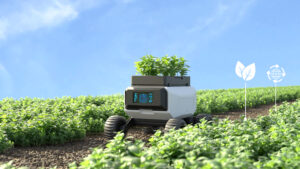
But there is a stubborn gap between a model that performs well in a lab and a weeding robot that holds its accuracy across seasons, geographies, and crop types. Teams that have shipped agricultural AI systems know where that gap lives. It lives in the training data.
Weeding robot accuracy is not just a function of the algorithm. It depends on the agronomy-driven intelligence behind the training data, and that is the gap most development teams underestimate until they are already in the field.
Why Generic Labeling Hurts Weeding Robot Accuracy
Fields are not controlled environments. They are dense, dynamic, and deeply ambiguous to any labeler who does not understand what they are looking at. Consider the surface-level challenge first:
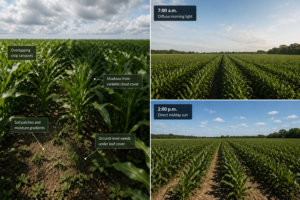
In a mature field, crop canopies overlap. Ground-level weeds tuck underneath leaf cover. Soil patches, moisture gradients, and shadows from variable cloud cover alter the way both crops and weeds appear in RGB or multispectral imagery. A frame captured at 7 a.m. in diffuse morning light looks nothing like the same frame at 2 p.m. under direct sun. Lighting alone creates visual variability that breaks models trained on narrow datasets.
Then there is the deeper problem: biological mimicry. Some of the most economically damaging weed species are those that most closely resemble the crop they invade. Barnyard grass in a rice paddy. Volunteer corn in a soybean field. Wild oat among cereal crops. These are not edge cases in crop and weed detection. They are routine challenges in commercial agriculture, and they are exactly the scenarios where generic annotators consistently fail.
A non-specialist labeler looking at a dense soybean canopy cannot reliably distinguish a young pigweed from a soybean seedling at growth stage V1. They do not know that a row gap in the center of a corn field may indicate a germination failure rather than a fallow patch. They cannot read field-level context into an image the way someone with agronomy training can.
That missing context does not just produce mislabeled images. It produces agricultural AI training data that teaches a model to be wrong, consistently and confidently, in exactly the conditions where a weeding robot is expected to perform.
What Field Intelligence Actually Looks Like in Practice
Agronomy expertise enters the pipeline at several distinct points, each of which has a direct effect on model performance.
- Plant layout and crop row line detection: Crops are planted in deliberate patterns. Row spacing, inter-row distance, planting population, and bed geometry are all agronomically determined. A specialist annotator understands that a plant appearing between crop rows is almost certainly a weed, while a plant that aligns with the row is almost certainly the crop, even when their visual appearance is similar. This positional intelligence, built on an expert understanding of planting layouts, is invisible to a generic labeler but is foundational to any reliable agricultural AI training data pipeline.
- Growth-stage-aware labeling: Both crops and weeds change dramatically in appearance from seedling to maturity. A model trained only on mature plant imagery will fail at early-season detection, when mechanical or laser-based intervention is most effective and least damaging to the crop. Agronomists understand the visual markers of each growth stage and can label accordingly, ensuring that training sets capture the full phenological range.
- Contextual scene interpretation: Soil color and texture communicate moisture levels. The distribution of plant height across a frame suggests whether lodging has occurred. The orientation of leaves can indicate heat stress or wind damage. These scene-level cues inform how an agronomist labels what they see, adding semantic richness to the annotation that a generic labeler would simply ignore. The result is agricultural AI training data that carries field intelligence rather than just pixel labels.
- Fallow ground identification: Not every frame in a field dataset contains a plant that requires action. Specialist annotators label bare soil, low-growth patches, and post-harvest residue accurately, teaching the robot to recognize when no intervention is needed. This prevents wasted energy, unnecessary laser firing, and false positives in regions where the field is simply resting.
Human-in-the-loop annotation for edge cases: No automated labeling pipeline handles edge cases well. The most consequential errors in weeding robot models tend to cluster around exactly the situations that automation cannot resolve: an unusual weed species photographed at an uncommon angle, a crop plant damaged by disease that no longer looks like itself, or a boundary region where two field zones meet and visual cues are contradictory. Human-in-the-loop annotation by agronomy specialists is the only mechanism that handles these cases with consistent reliability.
iMerit’s human-in-the-loop annotation model keeps specialist reviewers embedded in the labeling pipeline, not as a last-resort quality check, but as a structural component of the workflow. This is especially important in crop and weed detection, where the cost of a false positive is a destroyed crop plant and the cost of a false negative is a weed that seeds and compounds across an entire season.
From Expertise to Execution: Annotation Techniques That Encode Field Knowledge
Agronomy expertise matters most when it is paired with annotation methods sophisticated enough to carry that knowledge into the training set.
Pixel-perfect semantic segmentation is the standard for serious weeding robot development. Bounding boxes are insufficient for laser-based weeding systems, which need to know not just that a weed is present but exactly which pixels belong to it before firing. Agronomy-informed plant semantic segmentation, where each pixel is assigned a class based on specialist understanding of plant morphology and field context, is what makes that precision possible and it’s why laser-based weeding systems demand a fundamentally different approach to annotation.
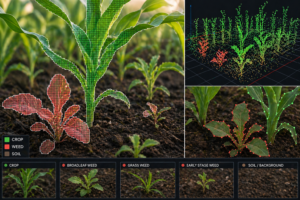
3D point cloud annotation extends plant semantic segmentation beyond the two-dimensional frame. Weeding robots increasingly operate with LiDAR or structured-light sensors that generate volumetric data. Annotating these point clouds requires understanding plant architecture in three dimensions, including canopy height, stem angle, and root zone proximity, all of which are agronomic concepts that shape how a specialist labels what the sensor sees. Models trained on expert-annotated 3D data generalize better to field terrain variation and are less likely to misfire when a crop plant leans over a weed. For a practical overview of available datasets in this space, see iMerit’s 20 Essential 3D Point Cloud Datasets for Precision Agriculture.
Polygon annotation for species-level localization. Weeds are not rectangles. Their shapes are irregular, species-specific, and growth-stage-dependent. Polygon annotation allows each plant instance to be bounded by a shape that conforms to its actual outline, giving the model richer geometric information for species discrimination. When polygon annotation is applied by specialists who understand the morphological differences between broadleaf and grass weeds, or between an early-stage dandelion and a thistle seedling, the resulting training data encodes biological knowledge that carries through to inference.
Case Study: Scaling from 80% to 95% Accuracy with Sentera
iMerit partnered with Sentera to improve crop feature detection at scale, focusing on corn tassel identification across diverse field conditions.
With agronomy-trained annotators and a human-in-the-loop workflow, edge cases like occlusion, dense canopies, and variable lighting were consistently handled.
Result: Accuracy improved from 80% to 95% across 1.2 million annotated instances
- Agronomy-trained annotators ensured correct labeling across growth stages
- Human-in-the-loop workflow handled edge cases (occlusion, dense canopy, lighting variation)
- Higher-quality, domain-informed training data improved model performance
See how this was achieved in production in the Sentera case study
Conclusion: Real-World Accuracy Requires Real-World Intelligence
Weeding robots that work in a test field but fail in commercial deployment share a common root cause. The training data did not reflect the complexity of real agricultural environments, and the annotators who produced it did not have the domain knowledge to close that gap.
Precision agriculture demands more than pixel labels. It demands annotation that carries agronomic understanding into every segmentation mask, every polygon boundary, and every scene-level classification decision. That understanding is what allows a model to maintain weeding robot accuracy as the season progresses, plant morphology changes, and new geographies introduce unfamiliar weed species.
If you are building weeding robots or precision agriculture AI systems, the data quality bottleneck is almost certainly in your annotation pipeline. Contact iMerit’s agricultural AI experts to learn how specialist-driven, human-in-the-loop annotation can scale your model’s performance from acceptable to production-ready.