Improving Crop and Weed Detection
With Expert Image Annotation

98.42 %

Accuracy

4.5 Million +

Images Processed

40 +

Crop Types Supported

iMerit helped an agricultural AI team improve crop and weed detection by delivering expert image annotation, human in the loop review, and consistent quality control across complex field imagery.

Challenge

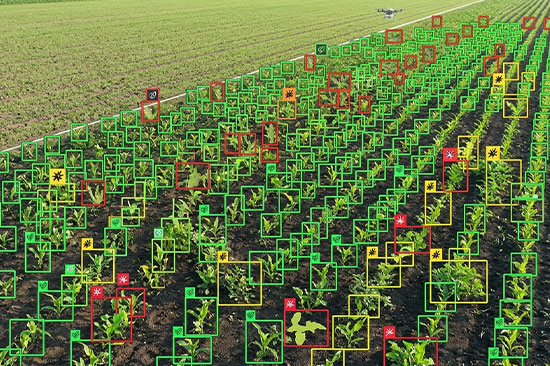
Early stage crop and weed detection is one of the most difficult computer vision challenges in agricultural AI. During the first stages of growth, crops and weeds can appear highly similar in color, shape, and size. These similarities make it difficult for AI models to reliably distinguish target crops from unwanted vegetation.

The challenge became more complex in dense field conditions where weeds often grew within crop rows. In these areas, accurate boundary creation was especially difficult, even when prelabels were used to accelerate the workflow. Variations in lighting, farm layouts, soil conditions, and crop growth patterns added another layer of complexity.

The team needed a scalable annotation approach that could improve consistency across millions of images while helping the model generalize across different farms and field conditions.

Solution

iMerit delivered a scalable crop and weed annotation workflow designed to improve model performance in complex agricultural environments.

  • Created clear crop and weed annotation guidelines
  • Reviewed complex and ambiguous field images
  • Validated prelabels for accuracy and consistency
  • Conducted calibration sessions to reduce rework
  • Applied focused quality checks on dense crop regions

iMerit provided expert human annotation support to help the client create high quality training data for crop and weed detection models. The workflow focused on resolving difficult visual distinctions during early growth stages, where crops and weeds often appeared similar in color, shape, and size.

To improve consistency, iMerit developed clear annotation guidelines and conducted regular calibration sessions with the review team.

Experienced reviewers were assigned to complex and ambiguous images, including dense field conditions where weeds grew within crop rows or overlapped with crop boundaries.

The team also validated prelabels, correcting inaccurate boundaries and ensuring that each image met defined quality standards. Focused quality control checks were applied to challenging regions, including areas affected by lighting variation, crop density, and inconsistent field conditions.

Result

The engagement delivered high quality annotated image data at scale, helping the client improve crop and weed detection performance across diverse agricultural settings. iMerit supported the processing of more than 4.5 million images across more than 40 different crop types, while maintaining 98.42% accuracy throughout the workflow.

By combining prelabels with expert human validation, iMerit helped the client accelerate the annotation process while maintaining strong quality standards. The final dataset gave the model stronger exposure to complex real world conditions, including dense crop rows, early growth stages, variable lighting, and field to field variation.

The improved annotation quality helped support better model generalization across farms and crop types, giving the client more reliable data for training and refining agricultural AI systems.