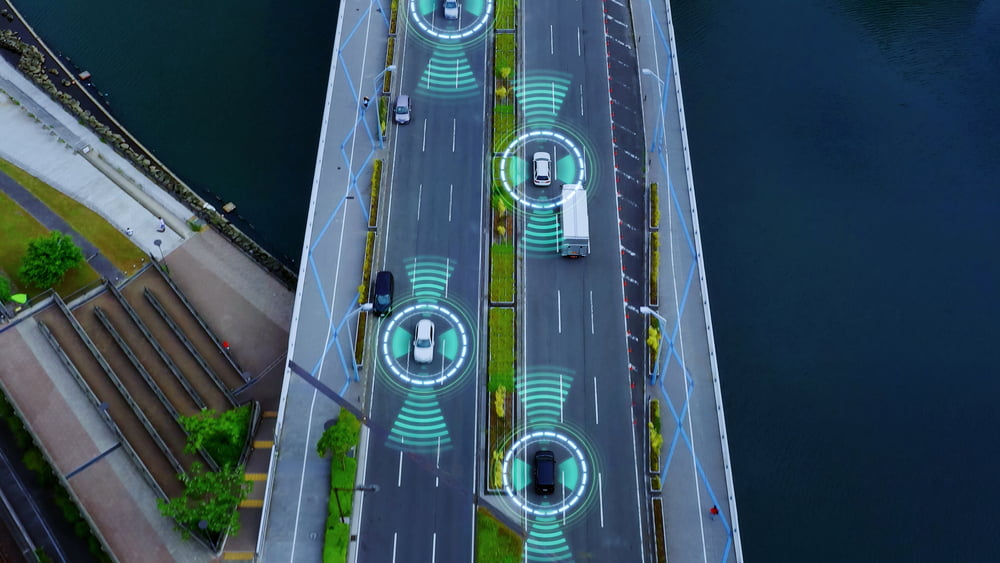
When a vehicle encounters a cyclist on a rainy evening, LiDAR captures exact distance and shape, the camera recognizes the bicycle form and rider clothing, and radar confirms movement direction and speed. Annotated fusion datasets teach perception models how to weigh each sensor’s contribution depending on conditions. Without high-quality labels aligned across these modalities, the model cannot learn which sensor to trust in which scenario.
Key LiDAR Sensor Fusion Annotation Challenges for AV and Robotics
Building reliable fusion datasets involves several technical and operational hurdles that perception teams regularly encounter.
Aligning Multi-Sensor Data
Sensors mounted on a vehicle rarely capture the same instant in exactly the same coordinate frame. LiDAR spins at one frequency, cameras trigger at another, and radar sweeps on its own cadence. Annotators need precisely calibrated extrinsic and intrinsic parameters to project 3D points onto 2D image pixels without drift. Even small timing offsets can shift a pedestrian’s bounding box by half a meter, which turns accurate labels into noisy training signals.
Maintaining Consistent Labels Across Fused 2D and 3D Views
When the same object appears in a camera frame and a LiDAR point cloud, its label must match in class, instance ID, and attributes across both views. A parked delivery van labeled as “truck” in the image but “car” in the point cloud will confuse any model trained on the pair. Cross-modal consistency requires annotation tools that display views simultaneously and propagate changes across sensors, along with reviewers who verify alignment frame by frame.
Scaling High-Quality LiDAR Sensor Fusion Datasets for Edge Cases
Rare scenarios cause most AV failures. Think construction zones with temporary signage, emergency vehicles, animals on highways, or partially occluded pedestrians. Capturing and annotating enough of these edge cases to meaningfully improve model performance takes large, targeted data pipelines. Teams that rely on generic annotation workflows often find their edge-case coverage too thin to move safety metrics.
Best Practices for High-Quality LiDAR Sensor Fusion Annotation
Strong annotation programs share a few consistent habits that separate production-ready datasets from prototype work.
Designing Robust 3D Point Cloud Labeling Schemas for Fusion Workloads
A thoughtful schema defines object classes, attribute fields, occlusion levels, and instance tracking rules before annotation begins. Schemas should accommodate fusion-specific labels like cross-sensor visibility flags and confidence scores per modality. Teams that invest time in 3D point labeling schema designs early avoid costly relabeling cycles when model requirements evolve.
Human-in-the-Loop Workflows to Train and Validate AV Models
Automated pre-labeling accelerates throughput, but trained human reviewers remain essential for catching subtle errors, rare object categories, and ambiguous scene interpretations. Effective human-in-the-loop pipelines route uncertain predictions to expert annotators, capture their corrections as ground truth, and feed those corrections back into model retraining.
Using Workflow Automation and Tooling to Support Multi-Sensor AV Projects
Purpose-built tooling handles projection, interpolation, and review queues more efficiently than generic platforms. Automation handles repetitive tasks like object tracking across frames, while annotators focus on judgment-heavy decisions. Quality dashboards, inter-annotator agreement metrics, and audit trails keep large programs on track.
Partner with iMerit for Expert LiDAR and 3D Sensor Fusion Annotation
Perception teams deliver safer autonomous systems when their training data reflects the messy, multi-modal reality their vehicles will encounter on the road. iMerit provides software-delivered services for data annotation and model fine-tuning that pair automation and analytics with human domain expertise. Our 3D sensor fusion and point cloud LiDAR annotation services support the full range of autonomous mobility projects, from highway perception to urban robotaxi deployments to off-road industrial robotics.
We work alongside your engineers to design schemas, scale edge-case coverage, and deliver annotated fusion datasets that move precision and recall metrics in the right direction. Whether you need cuboid labeling, semantic segmentation, or complex multi-object tracking across fused sensor streams, our teams adapt to your requirements and timelines.
Contact our experts today to discuss how we can support your next autonomous mobility milestone.