2D image annotation is essential for developing accurate AI models across various industries, including healthcare, autonomous driving, retail analytics, and facial recognition. Precise annotation, expert oversight, and strong regulatory compliance significantly enhance the effectiveness of AI-driven applications.
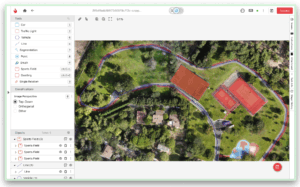
Let’s explore leading 2d annotation platforms and how they support diverse project needs in 2025.
Top Tools for 2D Image Annotation:
1. iMerit (Ango Hub)
iMerit’s Ango Hub is an advanced annotation platform purpose-built for precision AI development across high-stakes domains. It blends human expertise with automation to deliver scalable, secure, and high-quality annotations.

Features:
- Comprehensive Format Support: Extensive support for JPG, PNG, DICOM, and other common image formats.
- Advanced Automation Features: Smart segmentation, pre-labeling, automated bounding box generation, AI-assisted object detection, and annotation.
- Robust Integration Capabilities: Seamless integration with AI model pipelines, cloud storage solutions, and specialized industry software.
- Expert Workforce: Skilled annotators trained across various domains, ensuring precise and context-aware annotations.
- Strong Security & Compliance: Adherence to industry-specific standards, rigorous data security measures, audit logging, and secure access controls.
Best Use Case: Multi-domain, high-volume AI projects requiring clinical precision, automation, and regulatory compliance.
2. Scale AI
Scale AI excels in large-scale managed annotation services with stringent quality controls, ideal for extensive datasets.
Features:
- Speeds up labeling through machine learning–guided tools.
- Handles massive data volumes efficiently through managed teams.
- Supports tailored pipelines for AV, defense, and large enterprise deployments.
- Built-in reviews, scoring, and validation at multiple checkpoints.
- Streamlined integration into data and model training workflows.
- Optimized for clients prioritizing throughput over domain-specific nuance.
Best Use Case: High-volume, general-purpose annotation across autonomous systems and enterprise datasets.
3. Labelbox
Labelbox offers an enterprise-grade annotation platform known for customizable workflows and robust integrations suitable for various complex annotation tasks.
Features:
- Bounding boxes, segmentation, classification, and more.
- Build task-specific pipelines using visual or code-based editors.
- Supports embedding pre-trained models for iterative labeling.
- SOC 2 Type II, GDPR-compliant with team-based permissions.
- Compatible with cloud platforms and leading MLOps tools.
Best Use Case: Complex annotation workflows requiring enterprise-grade integration.
4. SuperAnnotate
SuperAnnotate provides powerful project management and efficient workflow solutions for complex annotation projects.
Features:
- Tools for bounding boxes, polygons, keypoints, and instance segmentation.
- Assign tasks, track progress, and manage QA cycles within the platform.
- Use ML models to pre-label or suggest annotations.
- Supports iterative improvements and peer reviews.
- Extendable to video and sensor fusion use cases.
Best Use Case: Projects requiring strong project management and streamlined annotation processes.
5. Dataloop
Dataloop delivers data-driven annotation automation and efficient handling of complex annotation workflows.
Features:
- ML model support for bounding boxes and segmentation
- Visual workflow builders for QA, annotation, and review loops
- Manages large datasets and integrates with cloud-native data sources
- Extend functionality with custom tools and dashboards
Best Use Case: Data-intensive annotation tasks requiring automation and flexibility.
6. Sama
Sama offers ethically sourced annotation services, combining accuracy, scalability, and social impact.
Features:
- Ethical sourcing of annotators
- Secure data pipelines with audit logs and compliance support
- Teams trained for AV, medical imaging, agriculture, and more
- Provides annotation task creation, QA tracking, and workforce management
Best Use Case: Ethical, high-quality annotation projects requiring both precision and social responsibility.
7. Cogito Tech
Cogito Tech specializes in precision-driven annotation, supported by experienced annotators, ideal for detailed labeling requirements.
Features:
- Annotators trained in healthcare, automotive, insurance, and more
- Tiered QA layers, rework cycles, and validation tracking
- Supports both short-term sprints and long-term annotation projects
- Compliant with HIPAA, ISO standards, and client-specific protocols.
Best Use Case: High-precision annotation tasks across multiple domains.
Conclusion
Choosing the right 2D image annotation tool requires balancing automation, expert oversight, compliance, and integration flexibility. While each tool brings distinct advantages, iMerit’s Ango Hub stands out for projects where:
- Diverse data formats like DICOM and PNG must be handled natively
- Automation needs to accelerate but not replace human judgment
- Domain knowledge is critical for annotation accuracy
- Security, auditability, and compliance cannot be compromised
For AI teams building precision-critical models in healthcare, autonomous mobility, and beyond, Ango Hub offers a powerful combination of automation, expertise, and flexibility, designed to future-proof your data pipeline.
Why iMerit Ango Hub Stands Out
Beyond its role as one of the top annotation tools, iMerit’s Ango Hub uniquely combines automation with deep domain expertise to serve high-stakes industries. With native support for diverse formats like DICOM and PNG, advanced pre-labeling and segmentation features, and annotators trained in specialized fields, it ensures every dataset is both precise and context-aware. Its strict adherence to regulatory and security standards makes it a trusted choice for AI teams building mission-critical models in healthcare, autonomous mobility, and other regulated sectors.