Clinical-Grade, Cost-Smart: Dual-Shore
Digital Pathology Annotation for Scalable Medical AI
A global pharmaceutical company partnered with iMerit’s Healthcare Scholars to build a dual-shore digital histopathology workflow, combining India-based pathologists for first-pass tissue slide annotation with U.S.-based subspecialist review. The model delivers clinical-grade labels at scale while keeping costs aligned with the realities of U.S. healthcare AI development.
Challenge
To train and validate its digital pathology models, the client needed large volumes of expertly labeled tissue slides across multiple disease areas and staining protocols. Each slide required nuanced interpretation of cellular morphology, tissue architecture, and rare edge cases; which is a type of work that traditionally depends on highly specialized pathologists.
Relying solely on U.S.-based pathologists for full-slide annotation made it difficult to:
- Scale labeling to match model development timelines
- Keep per-slide annotation costs within budget
- Preserve the depth of clinical review needed to meet U.S. expectations

At the same time, generic crowdsourced annotation was not an option. The models would directly support high-stakes clinical workflows, demanding:
- Pathologist-led oversight and multi-modal clinical context
- GxP Regulatory-ready processes for handling sensitive health data
- Consistent, reproducible labels across millions of tiles and whole slide images, not just simple region marking
The client needed a way to expand capacity with medically trained talent, without compromising quality or overspending on fully onshore annotation.
Solution
Dual-Shore, Expert-in-the-Loop Workflow
The client selected iMerit for its pathologist-led digital pathology annotation capabilities, HIPAA-compliant infrastructure, and tiered expert model that combines specialized annotators with board-certified physicians.
Working together, the teams designed a dual-shore workflow anchored in the Healthcare Scholars platform:
India-Based Pathologists for First-Pass Annotation
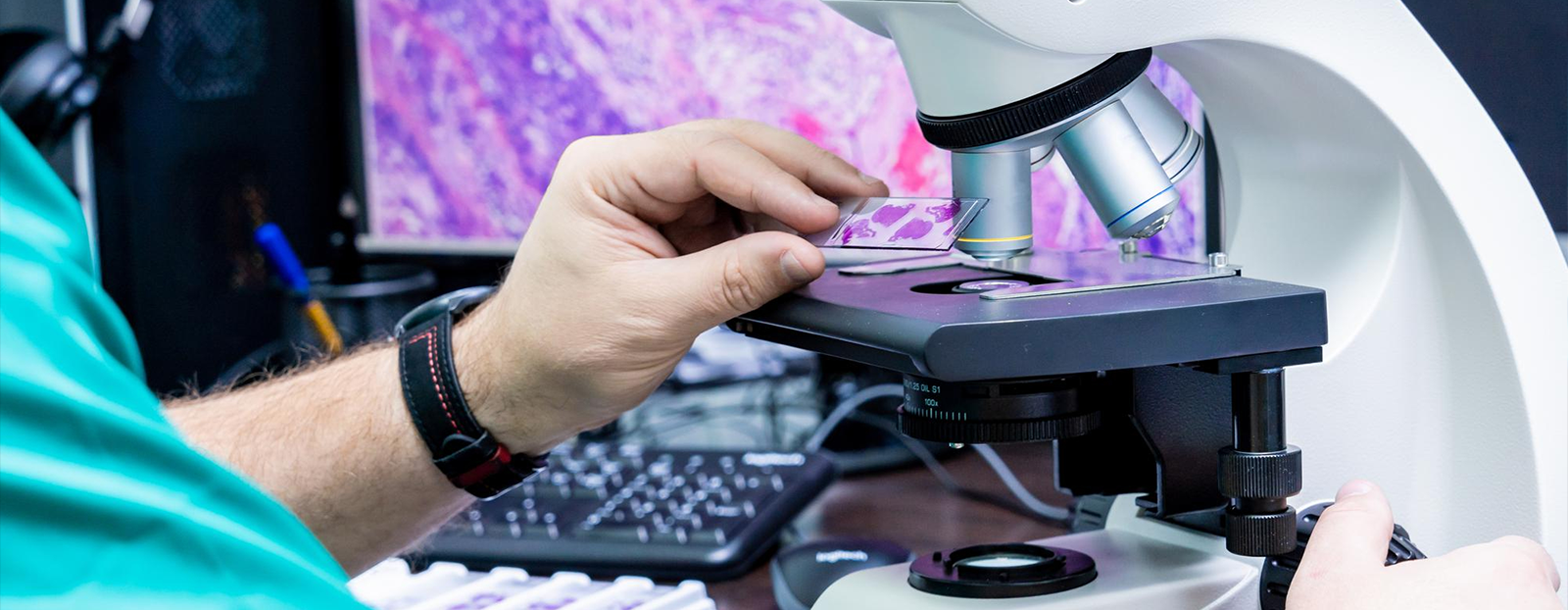
- Experienced pathologists in India performed the initial review and detailed annotation of tissue slides.
- The team followed project-specific guidelines covering regions of interest, cellular classifications, grading schemes, and artifact handling.
- Ongoing calibration sessions ensured consistent interpretation of ambiguous or borderline findings.
U.S.-Based Pathologist for Final Clinical Review
- A U.S.-based pathologist reviewed the first-pass annotations, focusing on complex edge cases, rare morphologies, and labeling consistency across studies.
- The U.S. reviewer refined guidelines, validated borderline labels, and confirmed that outputs aligned with the client’s target clinical use cases and regulatory expectations.
“By combining global expertise with localized clinical review, we were able to scale high-quality histopathology labeling without compromising clinical rigor or cost efficiency.”
- VP of Clinical Applications and AI
Result
By structuring work around a dual-shore, expert-in-the-loop model, the client achieved a balance of scale, cost efficiency, and clinical rigor:
Significant cost efficiency
Because the majority of annotation effort (tile-level labeling, region segmentation, and routine case handling) occurred in India, most of the work was billed at India rates. U.S.-based pathologist time was reserved for high-value review, complex edge cases, and final validation. This kept the project financially viable compared to an all-U.S. pathologist workflow.
Clinical-grade quality with global talent
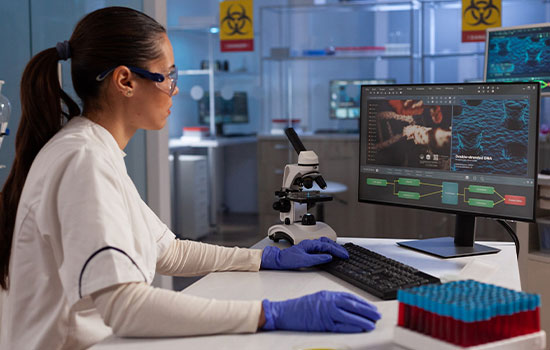
Disagreements and edge cases were fed back into guidelines and the training curriculum, progressively tightening inter-annotator agreement. Ango Hub platform and iMerit’s medical AI workflows provided audit trails, role-based access, and expert-in-the-loop QA, resulting in a dataset aligned with U.S. clinical expectations for digital pathology AI.
Scalable pipeline for digital histopathology AI
With a stable, dual-shore team, codified guidelines, and continuous feedback loops, the client could onboard new tissue types, stains, and experimental models without rebuilding its labeling operation from scratch. Over time, this digital histopathology workflow evolved into the client’s longest-running engagement with iMerit, supporting ongoing model iterations and new pathology use cases.
More time for innovation from senior experts
Because senior U.S. pathology expertise was no longer consumed by full-slide manual annotation, the client’s teams could focus on algorithm development, experimental design, and clinical validation. The dual-shore setup allowed U.S. pathologists to concentrate on subtle features, edge cases, and clinical nuance rather than repetitive markup, accelerating overall AI innovation.
Take Your Next Healthcare AI Workflow Dual-Shore
This digital pathology workflow is just one example of how Healthcare Scholars helps teams combine global clinical expertise with scalable, cost-smart annotation.
Visit our Healthcare Scholars Page to learn more about our medically trained workforce and capabilities. Contact us or schedule a demo to discuss how we can support your next healthcare AI use case.