AI safety is becoming increasingly challenging to manage as models are reused and deployed across an increasing number of systems. Many organizations still use fragmented evaluation practices, testing models inconsistently across teams and projects.
This creates risks as models scale, including hidden bias, unintended memorization, data leakage, and potential misuse. Forbes mentions that even leading AI models like ChatGPT-4 can hallucinate at high rates. Moreover, 71% of technology leaders report a lack of confidence in their organization’s ability to manage AI risks effectively.

These challenges highlight the need for a harmonized approach. Standardizing AI safety evaluations can help with consistent testing for bias and data leakage. It can help companies deploy models confidently.
Let’s explore an engineering-driven framework for AI safety evaluation that spans bias and data leakage prevention.
What Standardizing Safety Evaluations Means for AI Systems
Standardizing AI safety evaluations means creating a clear and shared method for testing how safe a model is before deployment. Standardization provides teams with a stable foundation that does not vary with model size, model type, or team preferences.
Using consistent metrics, datasets, and test protocols removes ambiguity. When everyone uses the same definitions of bias, leakage, and robustness, results are easier to interpret. Teams can understand what a “high-risk” or “low-risk” score means because the categories are uniform. Shared datasets and prompts also reduce noise in testing and prevent misleading results.
Standardization also makes comparison easier. Teams can compare two versions of the same model or two different vendors using the same evaluation method. This helps organizations track progress and make informed decisions about whether to deploy an update.
The Core Dimensions of AI Safety Evaluation
A complete AI safety evaluation should cover four core areas, which include bias, toxicity, privacy, and robustness. Each area focuses on a different risk and requires its own tools and test protocols.
1. Bias & Fairness Testing
Bias often comes from dataset imbalance, annotation drift, or linguistic and regional gaps. Models trained on such data can produce unfair or skewed outputs for certain groups. Fairness focuses on whether different groups receive comparable and equitable outcomes. A model can have balanced data and still appear accurate overall, while being unfair to specific groups.
Fairness testing builds on bias detection. It uses subgroup evaluations to measure model performance across defined groups, such as language, gender, age, or region. This helps teams see whether error rates or outputs differ between groups. Counterfactual prompts are also used. These prompts change only one sensitive attribute while keeping the rest of the input the same. If the model’s response changes in a meaningful way, it may indicate unfair behavior.
Mature frameworks support fairness benchmarking across LLMs, vision models, and multimodal systems. This allows teams to check whether model behavior changes across demographics or contexts.
2. Toxicity & Harmful Output Detection
Toxicity detection focuses on how a model behaves in sensitive or high-risk situations. Models must be checked for both direct and subtle toxic responses. This includes context-aware toxicity tests, adversarial safety probes, and structured red-teaming. Automated classifiers can scan large volumes of model output at scale. Human-in-the-loop workflows complement this by reviewing edge cases where context and nuance are critical.
3. Privacy & Data Leakage Assessment
Privacy tests check whether a model exposes information that should remain private. Leakage can happen through memorized training data containing sensitive information, extraction attacks, or reconstruction attempts.
Membership inference benchmarks help determine if an attacker can identify whether a record was part of the training set. Differential privacy–aligned tests also measure the model’s resistance to revealing sensitive information under stress.
Tools like iMerit can help reinforce privacy protocols for enhanced AI safety. For example, iMerit implemented a HIPAA-compliant de-identification process in a healthcare AI project to remove all personally identifiable information from 20,000 ultrasound videos before they could be used for AI model training.
The workflow combined automated tools with expert human review to ensure that no protected data remained. This allowed for safe model development while preserving privacy and compliance.
4. Robustness & Adversarial Behavior
Robustness testing examines how well a model handles manipulation. This includes prompt injection, jailbreak attempts, and distribution shifts that push the model outside normal conditions. Stress-testing multi-turn dialogue helps teams see whether safety mechanisms hold up over longer conversations. These tests show how a model behaves when users try to break guardrails or exploit unclear boundaries.
Together, robustness and adversarial testing form the foundation of an engineering-grade AI safety evaluation framework that supports safe AI deployment.
Challenges in Achieving Standardization
Creating a unified safety evaluation approach for AI systems is not simple. Below are some of the main challenges:
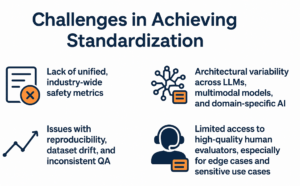
- Lack of shared safety metrics: Different organizations define bias or leakage differently, leading to inconsistent results. Without common metrics, it is hard to compare models or judge whether a system is safe enough.
- Diversity of AI architectures: Large language models, multimodal systems, and domain-specific models behave differently and require different test setups. A method that works for an LLM may not work for a vision-language model or a medical AI tool. This makes it difficult to design protocols that apply everywhere.
- Reproducibility and model drift: Models evolve quickly, and datasets can drift. Hence, an update can change behavior without warning. Teams often struggle to repeat the same test results across versions or environments. Inconsistent QA practices add more uncertainty and weaken confidence in evaluation scores.
- Limited availability of human evaluators: Many high-risk use cases require expert judgment, but access to trained reviewers is limited. This is especially true for sensitive topics, cultural nuance, or edge cases where automated tools fail. Hence, companies often rely on partial reviews or incomplete human oversight, which reduces evaluation quality.
Frameworks and Standards Driving AI Safety
Different safety frameworks focus on different risks, which complicates standardization across teams and systems.
ISO/IEC AI Standards (42001, 23894)
ISO and IEC are among the most recognized providers of AI safety standards. ISO/IEC 42001 defines an AI management system, while ISO/IEC 23894 focuses on AI risk management. These standards outline structured processes but do not offer detailed, model-level evaluation protocols, so teams still need to translate them into practice.
NIST AI Risk Management Framework
The NIST AI Risk Management Framework adds more technical guidance. It helps organizations map, measure, and manage AI risks. It also gives clear directions for robustness and bias testing. However, its flexibility means teams can interpret the framework differently, which limits cross-company consistency.
Responsible AI Model Cards & Safety Evaluation Cards
The Responsible AI Model Cards and Safety Evaluation Cards provide an opportunity to record the risks and test results. They enhance transparency by reviewing the model’s behavior, the data it takes, and the safety checks conducted. However, the format is not a complete standard throughout the industry.
EU AI Act Alignment for High-Risk Systems
The EU AI Act will push teams to adopt more formal evaluation methods for high-risk systems. It requires traceability, clear documentation, and regular testing. These requirements improve accountability and consistency. However, the Act does not define a single technical framework for how evaluations should be performed. Organizations must still choose their own metrics, datasets, and testing methods.
Building a Standardized Safety Evaluation Framework
A strong safety evaluation framework provides teams with a clear, repeatable way to measure model behavior. It turns vague ideas about “safe AI deployment” into defined tests, datasets, and workflows. Here are the core building blocks for building a reliable safety evaluation framework.
Safety Taxonomy Definition
A safety taxonomy is the foundation of any standardized evaluation system. It maps model capabilities to specific risk domains so teams know what to test and why. This includes defining clear vectors such as bias, toxicity, robustness, privacy leakage, and misuse potential. Each vector must have measurable indicators that allow for objective scoring.
Taxonomy can be more reliable when aligned with recognized standards such as ISO 42001 and the NIST AI Risk Management Framework. These standards guide risk classification, control processes, and documentation.
Input from domain experts is also important for sensitive fields such as healthcare, finance, or public safety. Experts help refine labels, curate edge cases, and reduce ambiguity in high-risk scenarios.
iMerit is well-positioned to support this step because it works across many data modalities, including text, vision, LiDAR, and medical imaging. Their experience with regulated workflows, such as HIPAA, also enables high-quality taxonomy creation and annotation in complex or sensitive domains.
Evaluation Dataset Schemas
Standardized safety evaluations depend on well-designed datasets. Attribute-balanced datasets help test fairness by ensuring groups are represented evenly. This reduces the risk of false conclusions caused by skewed samples.
For toxicity and adversarial testing, multilingual prompts and domain-specific queries enable teams to evaluate the model across varied cultural and linguistic contexts.
Evaluation datasets can come from two main sources:
- Synthetic data produced by LLMs
- Curated human datasets
Synthetic data helps scale testing quickly, but human-curated sets remain essential for cultural sensitivity and rare edge cases. Most effective pipelines use a mix of both.
iMerit provides fine-grained dataset engineering, bias-sensitive labeling, and multilingual safety annotation for teams requiring high-precision evaluation corpora.
Pipeline Design for Continuous Safety Testing
A modular evaluation pipeline ensures that safety checks run across the entire model lifecycle. Pipeline design should include:
- Modular evaluation components for bias, toxicity, robustness, and privacy
- Integration with MLOps platforms
- GitOps or CI/CD hooks to block unsafe model versions
- Batch and streaming evaluation jobs
- Automated scoring with human review loops
- Execution on GPU or CPU clusters for scalable testing
The pipeline should produce clear safety reports and highlight trends in model behavior. This helps teams detect drift early and maintain consistent safety levels over time.
Tooling Ecosystem: From Bias Detection to Leakage Prevention
A standardized evaluation framework needs strong tools that cover all core risk areas. Modern AI teams rely on a mix of open-source libraries, in-house tooling, and automated monitoring systems to detect safety issues early.
Bias & Fairness Tools
Tools like Fairlearn and AIF360 allow teams to measure fairness across demographic groups and detect biased patterns in predictions. Bias drift monitors track changes in fairness over time. For LLMs, automated bias surfacing tools generate counterfactual prompts to reveal hidden bias at scale.
Privacy & Leakage Tools
Canary injection helps detect memorization by inserting unique markers into training data. Membership inference simulators test whether attackers can identify if a sample was part of the training set. Training-data exposure scoring tools estimate the likelihood that a model will reveal private information under different prompts.
Robustness & Red-Team Evaluation
Prompt injection testing tools check whether a model’s safety rules can be bypassed. Adversarial content generators create inputs designed to push models into unsafe outputs. Automated LLM safety challengers run large red-team prompt sets to efficiently uncover jailbreaks and harmful responses.
Roadmap Toward a Universal Safety Standard
The development of a universal safety standard in AI necessitates common practice, clear assessment, and development guidelines. Key elements include:
- Model-agnostic gold-standard tests: Tests that work across LLMs, multimodal models, and domain-specific AI ensure consistent evaluation of safety across architectures.
- Cryptographically verifiable evaluation logs: Secure logs guarantee that results are tamper-proof. They also provide transparency and auditability for regulatory or internal review.
- Pass/fail thresholds per safety domain: Unambiguous limits on bias, toxicity, privacy, and robustness enable execution of deployment decisions.
- Shared corpora across industry and academia: Using common datasets enables standardized testing and fair comparisons between models.
- New safety requirements based on incidents: Standards need to change alongside new risks or failures found, to keep safety practices useful and impactful.
Conclusion
As AI models grow more complex, ad-hoc testing is no longer enough. Safety evaluation must become a structured engineering practice with clear tests, repeatable methods, and reliable metrics. Standardized evaluation frameworks help teams spot risks early and understand model behavior to avoid unexpected failures during deployment.
Key Takeaways
- The standardized LLM safety testing limits ambiguity and boosts confidence in the model’s performance.
- Bias, toxicity, privacy leakage, and robustness should be evaluated using consistent metrics.
- Ongoing analysis is crucial because models develop and data conditions vary.
- The presence of common standards and verifiable logs enhances transparency and accountability.
- Expert-curated datasets and human review remain important for high-risk domains.
Ready to build a reliable and scalable AI safety evaluation framework? Talk to an iMerit expert and design a safety workflow tailored to your models and risk needs.