Artificial intelligence has excelled at language, images, and code. The next major step is more radical: intelligence that can move, perceive, and perform in the physical world. This change, commonly known as Physical AI, is reinventing how robotic systems acquire knowledge and operate outside highly controlled settings.
Innovations from companies like NVIDIA make this direction clear: AI systems are no longer simply trained to predict or generate; they are now trained to interact with reality. For robotic technology, this is a milestone.
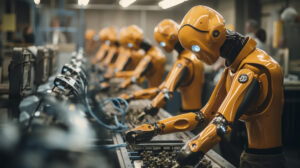
Recent announcements from NVIDIA around open vision-language-action (VLA) models and physical AI infrastructure for autonomous driving research highlight this transition in practice. These systems combine vision and language-conditioned policy generation with simulation tooling, synthetic scenario generation, and a closed-loop evaluation pipeline that allows models to be trained and tested in structured environments before deployment. The goal is not just perception accuracy, but also the ability to reason about context and execute safe actions under uncertainty in real-world environments.
From Digital Intelligence to Embodied Intelligence
Conventionally, robots were heavily dependent on algorithms, scripts, and narrow task automation. Physical AI, coining the combination of perception, reasoning, and control into a single learning loop, abandons that solution. Instead of relying solely on coded commands, robots acquire knowledge by:
- Looking at the world via multimodal sensors (e. g., visual, depth, tactile, auditory)
- Understanding the purpose, risk, and limitations
- Implementing and modifying their behavior at once.
This is how people learn, mostly by trial and error, assisted thinking, and doing.
Why Robotics Is the Natural Home for Physical AI
Robots operate in environments filled with uncertainty: shifting objects, imperfect lighting, human unpredictability, and safety-critical decisions. These are conditions where purely digital AI falls short.
Physical AI enables robotic systems to:
- Understand spatial context rather than isolated frames
- Generalize across tasks instead of memorizing workflows
- Recover from errors instead of failing silently
This is why robotics is emerging as the most demanding and most revealing testbed for next-generation AI.
Simulation, Synthetic Data, and the Real-World Gap
Training robots directly in the real-world environment is slow, expensive, and often unsafe, especially when systems are still learning. As a result, simulation has become a foundational pillar of Physical AI development. However, while simulation enables faster experimentation, it also introduces some of the most difficult technical and functional challenges in building reliable physical AI systems for robotics.
Modern robotic systems are trained using:
- Large-scale simulated environments that replicate physical spaces, objects, and interactions.
- Synthetic data designed to model rare, dangerous, or hard-to-capture edge cases such as near-collisions, sensor failures, or unexpected human behavior.
- Continuous transfer learning workflows that adapt models trained in simulation to real-world conditions.
The core challenge lies in the simulation-to-reality gap. To narrow this gap, teams employ techniques such as domain randomization (varying lighting, textures, and physics parameters), system identification and calibration to align simulation dynamics with real hardware behavior, and curriculum learning that gradually exposes models to increasing levels of environmental complexity. Real-world fine-tuning and residual learning are often layered on top of simulation-trained policies to correct for discrepancies that only appear outside simulation. Together, these approaches aim to reduce performance degradation when systems transition from controlled simulation to physical deployment.
Simulated environments, no matter how detailed, struggle to fully capture real-world variability, sensor noise, material properties, lighting changes, wear and tear, and unpredictable interactions. Models that perform well in simulation can fail when exposed to these subtle but critical differences in the physical world.
Unlike errors in purely digital AI systems, failures in physical AI can result in equipment damage, safety incidents, or operational downtime, making human judgment and oversight indispensable.
Beyond technical realism, there are functional challenges. Determining whether a simulated scenario truly reflects real operational risk requires domain expertise. Edge cases must be prioritized correctly, safety-critical behaviors must be validated before deployment, and failures must be analyzed in ways that simulation alone cannot automate. This makes evaluation, calibration, and human oversight essential throughout the training lifecycle.
The challenge, therefore, is not just creating more simulation data or larger models, but ensuring that training in simulated environments prepares Physical AI systems to behave safely, consistently, and predictably once simulation ends, and the real world begins.
The Role of Human Judgment in Physical AI
Physical errors, unlike textual or image ones, can lead to real-world consequences such as equipment damage, safety incidents, or production downtime. Because Physical AI systems operate in dynamic, unpredictable environments, human judgment remains a critical component that cannot be replaced by automation alone. Human-in-the-loop mechanisms are essential at multiple stages of the Physical AI lifecycle. During training and testing, human experts do more than review outputs; they evaluate whether model behavior aligns with real-world constraints, safety expectations, and operational realities before systems are exposed to live environments.
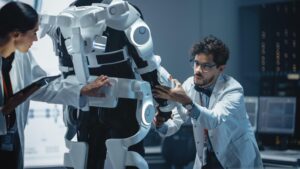
For example, in a warehouse robotics setting, a system may correctly detect a pallet but misjudge how close it can safely maneuver around a human worker standing nearby. While simulation may show clearance is technically sufficient, human reviewers evaluate whether that distance meets real operational safety standards and industry-specific safety margins. If it does not, braking thresholds, path-planning parameters, or object proximity rules are adjusted before deployment.
Edge cases also require domain expertise. Consider a robotic arm handling irregularly shaped objects. In simulation, grip success may appear high, but real-world conditions such as surface friction, slight object deformation, or lighting changes can cause grasp failure. Human evaluators review failure logs, sensor data, and environmental context to determine whether the issue stems from perception errors, grasp planning logic, or calibration drift. Based on this analysis, training datasets are refined, and evaluation benchmarks are updated to prevent repeated failure.
In deployment, human oversight becomes even more critical. For instance, if an autonomous mobile robot repeatedly slows down or stops in areas with reflective flooring due to sensor confusion, automated systems may simply log the anomaly. Human reviewers, however, analyze these events to determine whether sensor fusion weighting, environmental modeling, or obstacle classification requires adjustment. This allows teams to recalibrate the system before minor inconsistencies escalate into operational disruption.
Similarly, when a system encounters scenarios outside its confidence boundaries, such as unexpected human behavior or partially occluded objects, human evaluators assess whether the model responded conservatively enough. If not, safety rules and escalation protocols are strengthened. Unlike digital AI systems, where errors may be corrected after the fact, failures in Physical AI often demand immediate analysis to prevent cascading impact across equipment, workflows, or people.
Human expertise is also central to building high-quality datasets for Physical AI. Labeling, calibration, and evaluation tasks require contextual understanding of acceptable speed limits, safe interaction distances, material handling tolerances, and industry-specific compliance requirements. These judgments cannot be derived from simulation alone; they require informed human review.
Physical AI systems are most effective when automation and expert supervision evolve together. As models improve, structured human evaluation ensures that performance gains do not come at the expense of safety, reliability, or operational trust. This collaboration between intelligent systems and human judgment enables Physical AI to move from experimental capability to dependable real-world operation.
What This Means for the Future of Robotics
As Physical AI advances, robots will gradually move beyond repetitive automation to activities that require them to be adaptable, collaborative, and possess situational awareness.
These are the areas where we already have the first indications:
- Warehouse and logistics robotics, industrial inspection, and manipulation.
- Healthcare and assistive robotics.
- Autonomous mobility and service robots.
The ultimate change will not be in the creation of more intelligent machines, but in the development of systems that people can rely on even in the most dynamic environments.
Big Movement Ahead
Physical AI is a shift from AI that understands the world only to AI that lives within the world. For robots, it is not just a step up; it is a fundamental change. The coming wave of smart devices will not be determined by the quality of their outputs but by the safety, trustworthiness, and intelligence of their actions in the world.
Bringing Physical AI From Concept to Reality
As Physical AI moves from research labs into real-world deployment, success will depend less on model novelty and more on the quality, reliability, and judgment embedded in the data that trains these systems. Robots operating in dynamic environments require more than scale; they require precision, context, and expert validation across perception, simulation, and evaluation workflows.
This is where organizations like iMerit play a critical role. By combining domain-trained human expertise with structured data workflows, simulation support, and rigorous quality checks, iMerit helps ensure Physical AI systems are trained and evaluated to behave safely and predictably in the environments they are designed for.
As robots become active participants in the physical world, the future of Physical AI will be shaped not just by algorithms, but by the data, expertise, and governance frameworks that stand behind them.