Meeting the Real Hurdles of AI Approval
For MedTech AI teams, regulatory approval is more than a milestone. It is the gatekeeper between a promising model and clinical impact. Whether submitting to the FDA through a 510(k) or De Novo pathway, or aligning with MDR in the EU, the biggest blockers are often not in the model itself but in the data behind it.
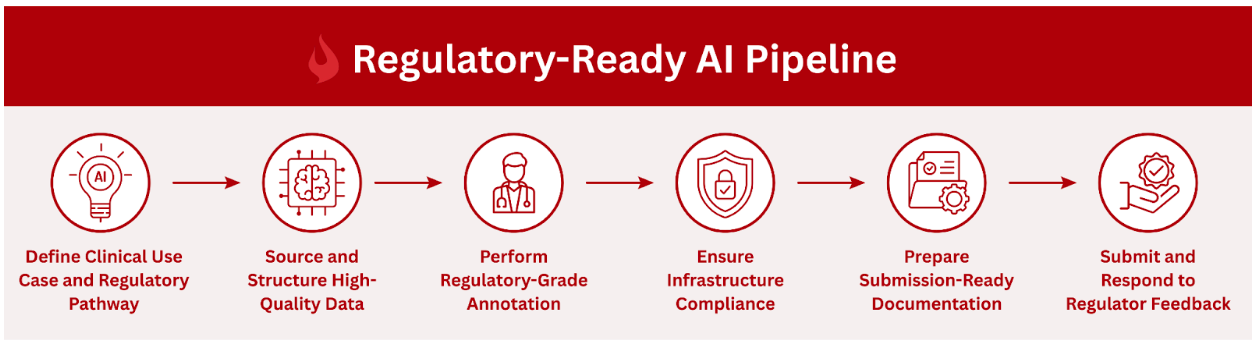
Many teams arrive at the regulatory phase with strong algorithms but limited readiness around validation datasets, documentation standards, and compliance infrastructure. At iMerit, we work with these teams to close critical gaps that emerge late in the development lifecycle, often when timelines and stakes are highest.
The Challenges of Regulatory AI in MedTech Before Submission
As regulatory expectations grow more stringent, AI teams are encountering a new set of data-driven challenges that can delay or derail approval. These are not theoretical risks; they are structural weaknesses that appear in even the most advanced AI projects.
1. Audit-Ready Annotations Are Harder Than They Look
Regulatory bodies are increasingly focused on the integrity of the training and validation datasets behind AI submissions. For annotations, this means more than just accuracy; it requires version control, digital traceability, role-based workflows, and consistent labeling across complex modalities like radiology, EHR text, and wearable sensor data. Many internal teams rely on tools or vendors that cannot provide this level of structured documentation.
Where the sector is moving
Organizations are building structured annotation workflows with quality assurance checkpoints and complete traceability. At iMerit, these pipelines are led by trained medical annotators and validated through tiered QA reviews. Work is done in secure environments and documented with audit logs, version histories, and digital signatures, ensuring annotations can be submitted as defensible evidence.
2. Validation Cohorts That Fail Clinical Scrutiny
Validation datasets are now a focal point in regulatory review. Regulators expect transparency into how cohorts are selected, how inclusion and exclusion criteria are applied, and how bias is identified and addressed. Many AI teams are underprepared to meet these demands, especially when repurposing legacy data or open datasets that lack clinical context.
What forward-looking teams are doing
To meet these expectations, MedTech developers are involving medical experts and regulatory partners in dataset design from the beginning. iMerit supports this shift through a network of medical SMEs who co-design validation cohorts, apply bias mitigation strategies, and align documentation with FDA or MDR expectations. This reduces the risk of rework and strengthens the submission’s foundation.
3. Infrastructure and Documentation Gaps Introduce Risk
Data security and documentation gaps are a common source of audit failure. Regulatory standards such as 21 CFR Part 11, HIPAA, and MDR Annex I require not only secure storage, but demonstrable control over access, data lineage, and process compliance. Many organizations struggle to maintain this level of rigor across globally distributed teams or during scaling phases.
iMerit’s solution
All data is processed in HIPAA, SOC 2, and ISO 27001-certified environments. Our infrastructure supports configurable access controls, automated audit logs, and ongoing compliance monitoring. Regulatory-grade tooling ensures submission-ready exports.
What Leading MedTech AI Teams Are Doing Differently
In response to these pressures, a clear pattern is emerging among the most successful MedTech AI organizations. They are not waiting for regulatory review to focus on compliance. They are operationalizing it from the start.
1. Building Annotation Pipelines with Submission in Mind
Annotation is no longer viewed as a back-office task. It is designed with traceability, documentation, and review-readiness built in from day one.
2. Involving Medical Experts in Validation Design
Clinical SMEs are now central to cohort strategy. Their involvement ensures that validation datasets are representative, defensible, and aligned with clinical realities.
3. Investing in Secure, Compliant Infrastructure
Teams are selecting platforms and partners based on compliance strength and audit-readiness, not just speed or convenience.
4. Maintaining Clear, Ongoing Documentation
Documentation is treated as a continuous deliverable, not a final step. This includes SOPs, labeling guidelines, QA records, and bias mitigation strategies.
These practices are becoming essential for companies building diagnostic models, clinical support tools, and real-world evidence systems. By embedding compliance into their workflows, they reduce submission risk and accelerate regulatory timelines.
Why Teams Preparing for FDA and MDR Choose iMerit
| What They Need | How iMerit Helps |
|---|---|
| Audit-ready, compliant annotations | Structured workflows with full traceability and documentation |
| Clinically validated validation cohorts | SME-guided cohort design and bias mitigation |
| Regulatory-aligned infrastructure | HIPAA, SOC 2, and ISO 27001 environments with continuous monitoring |
| Submission-ready outputs | Smart tooling with pre-labeling, QC checkpoints, and reproducible exports |
| Scalable, expert workforce | Medical annotators and governance models for rapid execution |
Turning Compliance into Competitive Advantage
Compliance is no longer a checkbox; it is a strategic differentiator. MedTech AI teams that approach regulatory requirements with structure and foresight are gaining a faster, more confident path to approval. At iMerit, we help make that shift possible by embedding regulatory alignment into every stage of the data lifecycle.
If you are preparing for an FDA or MDR submission, this is the moment to ensure your data workflows are as rigorous as your model.
Let’s talk about how iMerit can help you accelerate approval with confidence.
Schedule a Demo or Contact Us to learn how iMerit can streamline your path to approval.